
Once again, the headlines drip with blood. More violence. More suffering. More death.
The most recent series of attacks (and counterattacks) in the Middle East have captured the attention of the world. Thousands of Israeli and Palestinian casualties have already been reported. The horrifying stories and images of bloodshed fill our news feeds, tragically illustrating the latest chapter in an ongoing conflict that has rocked the region for decades.
Watching these events unfold from the comforts of our own peaceful lives several thousand miles away can be an incongruous experience. On the one hand, we’re so far removed that it’s hard to appreciate the despair and terror of those on the front lines. Our lives aren’t at risk. Our neighborhoods aren’t burning. At any point we choose, we can simply turn off the television and walk away.
On the other hand, we have such immediate access to unlimited up-to-the-minute coverage that we can easily find ourselves vicariously immersed in the drama – and trauma – of warfare. We can see the explosions. We can hear the screams. In many ways, we feel invested in each new development.
Adrift in this paradox of emotions, an important question begins to emerge: How should we engage with the latest news – and all the public discourse it generates? When faced with a global crisis such as this, what does a healthy response entail?
I can’t presume to offer a sufficient answer. But in reflecting upon these events, there do appear to be several obvious actions not to take. For example…
Maybe we should not pretend to know more than we do.
As I saw the reports begin to emerge, I braced myself for the hasty responses and self-assured commentary that would inevitably come. After all, there’s no shortage of pundits and grifters who will eagerly grab a microphone and tell us what to think.
But as easy as it is to criticize others, I have to be careful that I don’t fall into the same trap. I’m no expert on complex matters of international policy, nor am I a historian who understands the deep foundations of violence leading up to this most recent outbreak. Seeing a 30-second video clip on social media or reading a few CNN articles doesn’t qualify me to pronounce judgment. It’s okay for me to be ignorant. And it’s okay for me not to pretend otherwise.
There’s something about our uniquely American hubris that convinces us we can have everything all figured out, even in the face of awful tragedy. We think we can know who is at fault, how it all transpired, and what needs to happen next.
But maybe this is a moment for us to embrace our limitations. A moment to settle in and get comfortable with the questions. As we watch these horrifying events unfold, it’s enough to offer the world our grief, our sympathy, and our prayers. Let’s not assume we owe them our answers, as well.
Maybe we should not use this opportunity to score cheap political points.
In the immediate wake of the initial violence, my state’s Attorney General took to social media to tout his own credentials, while placing the blame for these attacks at the feet of none other than President Biden:
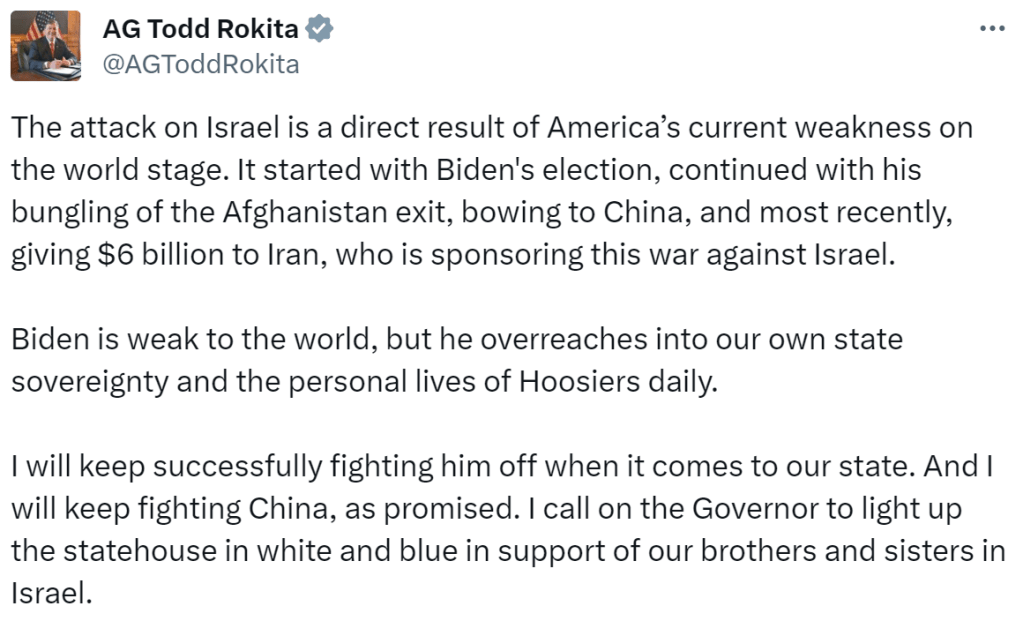
Regardless of one’s party affiliation or political loyalties, this sort of rhetoric has no place whatsoever. Real human lives are being lost. Real communities are being torn to pieces. This is so much bigger than our own silly elections and petty disagreements.
There’s a word for the impulse to turn tragedy into a partisan battering ram. Narcissism. That may sound like a harsh condemnation, but how else should we describe such self-absorbed delusion? If ever there’s a time to set aside our own agendas and unite together in mourning, this is it. Our failure to do so says way more about ourselves than our tweets and sound bites could ever say about our opponents on the other side of the aisle.
Maybe we should not entertain dehumanizing spiritualizations.
In certain realms of the evangelical Christianity I grew up with, there exists a strange fascination with the “end times.” And at the center of this fascination is a warped fixation on large-scale tragedy – especially when it takes place in the Middle East. According to a particular interpretation of certain biblical texts, present-day Israel is at the center of the eschatological timeline. So when something significant happens there, it could very well be a sign of the end of the world as we know it – which is a development many Christians eagerly anticipate.
The problem with this shouldn’t be hard to detect. How might an Israeli citizen feel about being told his suffering is good news for those awaiting the second coming of Jesus? How might a Palestinian child react to finding out her dead family is an exciting fulfillment of someone’s evangelical prophecy charts?
Let me be clear: Everyone is entitled to their own religious beliefs. But if those beliefs make you giddy about an outbreak of war, speculating that it could usher in a long-awaited “rapture” or some sort of “great tribulation,” then maybe it’s time to rethink things.
Hijacking a tragedy for one’s own theological self-interest is surely among the most deplorable crimes of religion. Whatever we believe about God and the future, the most important focus of everyone’s attention right now should be the suffering that our fellow humans are experiencing, not what our religious tribe stands to gain from someone else’s devastation.
Maybe we should not limit our compassion to only one side.
I understand that as a nation, the United States has formal loyalties to one party in this conflict. In light of that, it’s understandable for many Americans to have a natural affinity for the side with whom we have long-standing diplomatic relations.
But there’s a fine line between an international alliance and outright Islamophobia (or, on the flip side, Anti-Semitism), and we should be careful in these moments lest we inadvertently take a dangerous step across it.
The true horror of war is that it implicates a great number of citizens who would never fire a rocket launcher or toss a grenade. They’re simply normal human beings, living their lives and caring for their families, trying to survive in a world of perpetual hostility. Do any of them deserve to die because of their country of origin or their ethnic background? Does the religion of their ancestors make them less worthy of life than someone born merely a few miles away?
Maybe I’m an idealist, but I think it’s entirely possible to grieve with victims on both sides of these attacks. And what’s more, I think that doing so is a way to demonstrate – and preserve – our shared humanity.
These are contentious times. Hatred lurks just around the corner. But a liberal dose of unqualified compassion could go a long way toward making sure it can’t secure a foothold within our society.
Maybe we should not succumb to the shackles of anxiety.
Fear has an insidiously addictive quality about it, and in moments like this we’re all especially vulnerable. It’s what keeps us glued to the latest reports; it’s what keeps us doom-scrolling late into the night. But in the end, the only thing our fear can accomplish is to imprison us within an endless cycle of unproductive worry. It doesn’t make the world a better place, and it certainly doesn’t make us better global citizens.
This isn’t to suggest that the violence in Gaza isn’t important, nor is it to suggest that we should simply turn and look the other way when bad things happen. By all means, we should honestly confront the darkness of our world.
But living in a constant state of anxiety is unsustainable and unhealthy. It’s not a bad thing to step away from time to time. To breathe fresh air. To recalibrate ourselves and our emotions. The wise words of Wendell Berry provide a much-needed elixir (and a fitting benediction) for troubled people living through troubled times.
When despair for the world grows in me
and I wake in the night at the least sound
in fear of what my life and my children’s lives may be,
I go and lie down where the wood drake
rests in his beauty on the water, and the great heron feeds.
I come into the peace of wild things
who do not tax their lives with forethought
of grief. I come into the presence of still water.
And I feel above me the day-blind stars
waiting with their light. For a time
I rest in the grace of the world, and am free.
“The Peace of Wild Things”
Want to support my work? Subscribe to my newsletter so you’ll never miss out on new content! And if you’re feeling extra generous, consider leaving a small tip using the form below.
These words are free.
But if you enjoy what you’ve been reading, feel free to leave a tip. This makes it possible for me to keep the website alive and continue making writing a priority. Just choose your amount:
Or enter a custom amount:
Thanks for your support!

